
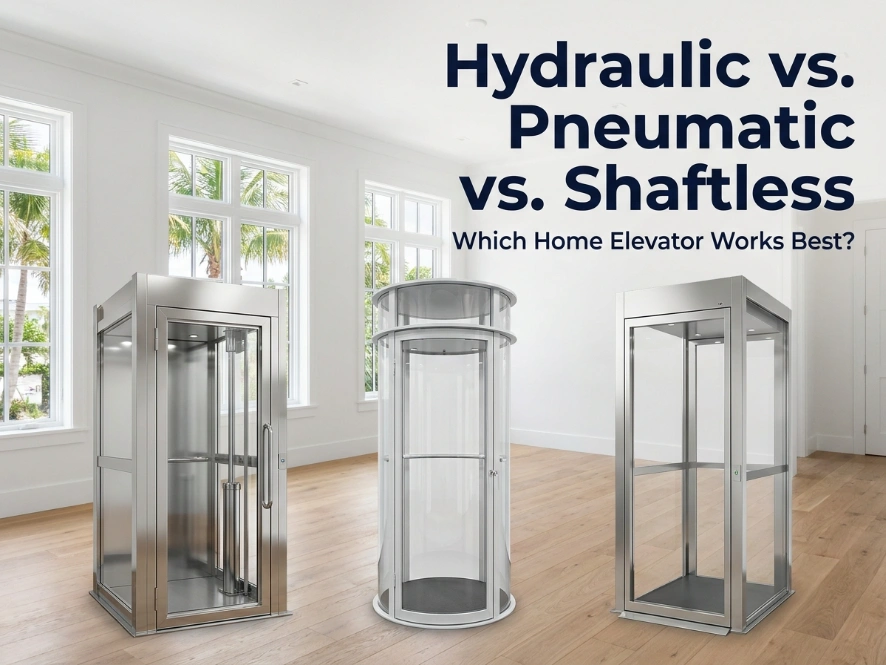
If you own a multi-story home and you are thinking about adding an elevator, the first question most homeowners face is also the hardest one: which type is actually right for my house? Not right for someone else’s house. Yours. With your floor plan, your budget, your family’s needs, and your timeline.
The three systems you will encounter most often are hydraulic, pneumatic, and shaftless home elevators. They all move people between floors, but they work in completely different ways, cost different amounts to install and maintain, and require very different structural changes to your home.
This guide will walk you through how each drive system works, what it physically requires, how it performs over time, and which type makes the most sense for your home.
Here is what this guide covers:
- How hydraulic, pneumatic, and shaftless systems actually work
- What each type requires in terms of shaft, pit, and machine room
- Installation timelines and cost ranges for 2025 and 2026
- Energy efficiency and long-term maintenance expectations
- Which system fits Florida coastal homes and existing home retrofits
- How Coastline Lift helps homeowners in the Florida Panhandle choose the right fit
How Does a Hydraulic Home Elevator Actually Work?
A hydraulic elevator uses a piston-and-pump mechanism to move the cab. Pressurized hydraulic fluid pushes the piston upward to raise the cab, and a controlled release of that fluid lowers it back down. The pump and fluid reservoir are stored in a separate machine room, typically a closet or utility space on the ground floor.
These systems have been the residential standard for decades. They are smooth, capable of carrying significant weight, and well-suited to new construction elevator projects.
What a hydraulic elevator requires:
- A full hoistway or dedicated vertical shaft built into the home
- A pit below the lowest floor, typically 8 to 14 inches deep
- A machine room adjacent to or directly below the shaft
- 110V or 220V electrical service for the pump motor
- One to two weeks for installation in most homes
Weight capacity:
Hydraulic elevators commonly support between 750 and 1,400 lbs depending on the model. This makes them a strong choice for homes where the elevator will carry mobility equipment, heavy furniture, or multiple passengers at once.
Long-term maintenance:
Hydraulic oil must be monitored and occasionally replaced. Annual inspections should include fluid checks, piston inspection, and pump performance review. Any fluid leak, however small, requires prompt professional attention. In coastal environments, salt air accelerates corrosion of metal components, which raises maintenance costs over time. Homeowners dealing with ongoing issues should review common home elevator problems and solutions before committing to a system.
For homeowners building new construction or planning a major renovation who need high capacity across three or more floors, hydraulic systems remain a strong contender. For existing homes, the structural demand and installation disruption is significant and should be weighed carefully before committing.
What Is a Pneumatic Vacuum Elevator and How Is It Different?
A pneumatic home elevator moves using an air pressure differential rather than cables or hydraulic fluid. A vacuum turbine mounted at the top of a polycarbonate cylinder creates a pressure difference above and below the cab. The cab rises when pressure is reduced above it and descends when pressure equalizes in a controlled, gravity-assisted drop.
The result is a system with no shaft, no pit, and no machine room. The entire structure is self-supporting. It installs directly on your existing floors, anchored at the ceiling of each level it serves. If you want to understand how this compares to traditional systems, read our full breakdown of pneumatic vs traditional elevators.
What a pneumatic elevator requires:
- A floor opening at each level it serves
- Standard 110V or 220V electrical service
- Overhead clearance at the top floor for the turbine
- No pit, no shaft construction, no machine room
- Two to three days for installation
PVE model lineup and weight capacities:
| Model | Passengers | Weight Capacity | Best For |
| PVE 30 | 1 | ~350 lbs | Single passenger use |
| PVE 37 | 2 | ~450 lbs | Two adults |
| PVE 52 | 2 with wheelchair | ~525 lbs | Accessibility and mobility needs |
| CoastVue Cube | 2 | ~450 lbs | Modern design aesthetic |
Energy efficiency:
The turbine only draws power during ascent. Descent is gravity-assisted and requires no electricity at all. For homeowners focused on the most energy-efficient residential elevator options in 2025 and 2026, pneumatic systems rank favorably compared to hydraulic and most cable-driven alternatives.
The transparent polycarbonate cab works beautifully in open-plan homes, beach houses with wide sight lines, and luxury home interiors in Florida where the elevator becomes a visual statement rather than a utilitarian box.
What Makes a Shaftless Home Elevator Different from Both?
A shaftless home elevator sits between pneumatic and hydraulic systems in complexity and installation requirements. Rather than requiring a full hoistway, shaftless elevators use a compact, self-contained unit that mounts through a standard floor opening without building a shaft from ground to roof.
The cab travels along a rail system mounted inside the unit. Drive options include a cable and drum mechanism, a chain drive, or in newer models, a variable frequency drive (VFD) that controls motor speed for smoother starts and stops.
What a shaftless elevator requires:
- A floor opening at each level, typically 17 to 24 square feet footprint
- Small overhead rail above the top floor, usually 12 to 14 inches
- A shallow pit in most models, with pitless configurations available
- No machine room required
- Three to five days for installation in existing homes
Popular shaftless models available through Coastline Lift:
| Model | Capacity | Key Feature |
| Savaria VueLift Round Acrylic | Up to 950 lbs | Panoramic 360-degree visibility |
| Savaria VueLift Octagonal Glass | Up to 950 lbs | Premium glass design |
| Level Up Whisper Standard | Up to 750 lbs | Near-silent operation |
| Level Up Whisper Grand | Up to 750 lbs | Larger cab, quiet drive |
| Level Up Luma Lift | Up to 750 lbs | Clean architectural finish |
Cost range:
Shaftless home elevator cost with installation in 2025 and 2026 typically falls between $30,000 and $55,000, depending on model, configuration, and number of floors served. For a broader look at what to expect, see our guide on home elevator prices in the USA.
For homeowners who want a design-forward elevator with strong capacity and minimal construction disruption, shaftless systems are often the right answer.
How Do Installation Requirements Compare Across All Three Types?
Installation is where these three systems differ most sharply. For homeowners in existing homes, it is often the deciding factor.
| Feature | Hydraulic | Pneumatic | Shaftless |
| Shaft Required | Yes | No | No |
| Pit Required | Yes, 8 to 14 inches | No | Minimal or optional |
| Machine Room Required | Yes | No | No |
| Installation Time | 1 to 2 weeks | 2 to 3 days | 3 to 5 days |
| Best For | New construction | Existing home retrofit | Existing home retrofit |
| Structural Work | High | Minimal | Low to moderate |
| Cost Range 2025 to 2026 | $40,000 to $75,000 | $25,000 to $45,000 | $30,000 to $55,000 |
Hydraulic requires the most preparation. You need to frame a new shaft, cut into floors, and create space for mechanical equipment. In new construction this is planned from the start. In an existing home it can add weeks of contractor work before the elevator crew even arrives.
Shaftless requires a floor opening and minimal framing, small overhead clearance, and in most models a shallow pit. No machine room is needed. Most existing-home retrofits complete within a week. For a full walkthrough of what to expect, our home elevator installation guide covers every step.
Pneumatic requires only floor openings, ceiling clearance for the turbine, and standard electrical service. The self-supporting polycarbonate tube anchors to the structure at each floor. It is the most straightforward of the three to retrofit into an existing home.
For homeowners specifically asking about a home elevator with no pit, no shaft, and no machine room, pneumatic is the direct answer. For those who need more capacity or a more traditional cab appearance with minimal construction, shaftless fills that gap.
Which Type Has the Lowest Long-Term Maintenance Cost?
Maintenance is a cost many homeowners underestimate at the point of purchase. The difference between these systems adds up meaningfully over a 20 to 25-year service life.
Hydraulic maintenance requirements:
- Annual inspection of pump, piston, fluid levels, and safety systems
- Periodic hydraulic fluid replacement
- Piston seal monitoring, as seal failure is a costly repair
- Corrosion checks on metal components, especially in coastal climates
- Highest overall maintenance cost of the three types
Pneumatic maintenance requirements:
- Annual turbine inspection and seal check
- Safety system testing
- No fluid, no cable, no drum, and no pit equipment to service
- Turbine is accessible at the top of the unit without structural disassembly
- Lowest overall maintenance cost of the three types
Shaftless maintenance requirements:
- Periodic cable inspection and drum lubrication on cable-drive models
- Motor checks and VFD system review on VFD-drive models
- Annual safety system and obstruction sensor testing
- Moderate and predictable costs with a proper maintenance plan
For Florida coastal homeowners, the corrosion resistance of each system matters just as much as the mechanical service schedule. Salt air degrades metal components, hydraulic fluid systems, and standard cable mechanisms more aggressively than inland environments. Pneumatic systems, built with aluminum and polycarbonate construction and no hydraulic fluid, hold up well in coastal conditions. Coastline Lift selects every product with Florida salt air, wind-load requirements, and waterfront home elevator durability in mind.
Which Home Elevator Type Is Best for a Florida Coastal or Beach House?
This is a question Coastline Lift fields regularly from homeowners across the Emerald Coast. The answer depends on three factors: the home’s construction type, how many floors the elevator needs to serve, and how much structural modification the homeowner is willing to take on.
Most coastal homes in Panama City Beach, Destin, 30A, and across the Florida Panhandle are built on pilings or elevated slabs. Floor-to-floor heights are often taller than standard residential construction, and open floor plans make shaft construction disruptive to the living space.
Why pneumatic works well for Florida coastal homes:
- No pit excavation required, which is critical for piling-constructed homes
- Fast 2 to 3-day installation minimizes disruption to vacation or seasonal properties
- Polycarbonate and aluminum construction holds up well in salt air
- Self-supporting structure does not require interior shaft framing
Why shaftless works well for Florida coastal homes:
- Higher weight capacity than pneumatic for households with heavier loads
- Design options including panoramic glass and LED lighting match Emerald Coast luxury aesthetics
- Savaria VueLift and Level Up Whisper series are selected specifically for coastal durability
- ADA-compatible configurations available for aging-in-place homeowners
Every Coastline Lift installation meets ASME A18.1 safety standards and Florida Building Code requirements. Emergency lowering, obstruction sensors, and battery backup systems are standard on every project.
Why Coastline Lift Is the Right Choice for Your Home Elevator
Coastline Lift is locally owned and operated in Panama City Beach. Every installation is performed by the company’s own certified crew with no subcontractors, no national call center handoffs, and no rotating technicians who do not know your home.
Coastal engineering expertise. Every system Coastline Lift carries has been evaluated for performance in salt air, wind-load conditions, and Florida’s coastal building environment. This is a company built specifically to serve Emerald Coast homeowners, not a generic national dealer. See who we serve and our full service areas across the Panhandle.
Authorized dealer for PVE, Savaria, and Level Up. All three manufacturers are among the most respected in North America. All products are USA or Canadian-made. Homeowners get factory-backed warranties and access to genuine parts through an authorized channel. Browse the full product list to explore every available model.
Fast, low-disruption installation. Most pneumatic projects complete in two to three days. Most shaftless installations finish in three to five days. The certified crew protects the home throughout the process with a clean result from first call to final ride. Learn more about our post-construction elevator services for homes that are already built.
Transparent pricing with no pressure. Residential elevators typically range from $25,000 to $75,000 depending on system, configuration, and scope. Detailed pricing is provided during a free in-home consultation with no obligation and no upsell pressure. Flexible financing options are available.
Lifetime support after installation. Flexible maintenance plans, scheduled inspections, part replacement, and 24/7 emergency service ensure the elevator performs reliably for its full service life. A well-maintained elevator lasts 20 to 25 years. Read what our customers say on our reviews page.
Frequently Asked Questions
What is the main difference between a hydraulic, pneumatic, and shaftless home elevator?
A hydraulic elevator uses pressurized fluid and a piston to move the cab, requiring a full shaft, pit, and machine room. A pneumatic elevator uses air pressure differential and needs no shaft, pit, or machine room. A shaftless elevator uses a compact self-contained rail system that passes through floor openings without a full hoistway. Each type differs in installation complexity, space requirements, and long-term cost. For more answers, visit our FAQs page.
Which home elevator type requires the least structural modification to an existing home?
Pneumatic vacuum elevators require the least structural modification. They need only a floor opening at each level, standard electrical service, and ceiling clearance for the turbine. No shaft construction, no pit excavation, and no machine room are required.
Which type of home elevator is the most energy-efficient?
Pneumatic vacuum elevators are typically the most energy-efficient. Descent is gravity-assisted and requires no power. The turbine only draws electricity during ascent. Among the best energy-efficient residential home elevators for 2025 and 2026, pneumatic systems rank favorably against hydraulic and cable-driven alternatives.
Which home elevator type is best suited for a Florida coastal or beach house?
Both pneumatic and shaftless systems are well-suited to Florida coastal homes. Pneumatic systems are particularly practical for piling-constructed homes where pit excavation is difficult or impossible. Both types hold up well in salt air conditions when installed with the right materials by an experienced coastal elevator company in Florida.
Can a pneumatic or shaftless elevator access more than two floors?
Yes. Pneumatic vacuum elevators are available in two-stop and three-stop configurations. Shaftless systems can typically serve two to four floors depending on the model and available overhead clearance. Hydraulic systems can also serve multiple floors but require more structural planning per additional stop.
Conclusion
Every elevator type in this guide works well when matched to the right home. Pneumatic fits existing homes fastest with the least disruption. Shaftless gives you more design flexibility and higher capacity without a full shaft build. Hydraulic makes the most sense when you are building new and need maximum load capacity across multiple floors.
If you are in the Florida Panhandle and ready to find out which system fits your home, Coastline Lift LLC is the place to start. Call (850) 558-5331, email sales@coastlinelift.com, or contact us today to book your free in-home consultation.
