
Florida homeowners are adding residential elevators at a faster rate than almost any other state in the country. The reasons are straightforward: aging-in-place planning, multi-generational living, and the high value of coastal properties that warrant premium upgrades. Whether you are designing a new building in Destin or renovating a beach house on 30A, the decision of when and how to install a home elevator will shape everything from your construction timeline to your long-term budget.
The difference between planning an elevator during the design phase versus adding one after the home is finished is not just a matter of convenience. It affects structural complexity, total project cost, permit sequencing, and the range of elevator models available to you. Both paths are viable, but they require different strategies.
This guide covers everything a Florida homeowner, builder, or architect needs to know before committing to a residential elevator installation.
By the end of this article, you will understand:
- The real cost difference between installing during new construction versus retrofitting an existing home
- Which elevator types work best for new builds and which are designed for minimal-disruption retrofits
- How to plan shaft space, structural framing, and electrical requirements at the blueprint stage
- What Florida permits and building codes apply to residential elevator installations
- How coastal conditions in the Florida Panhandle, Destin, and 30A affect product selection and long-term durability
Does Timing Your Elevator Installation During Construction Actually Save Money?
Yes, installing a home elevator during new construction is consistently less expensive than retrofitting one into a finished home. The savings come from several places at once.
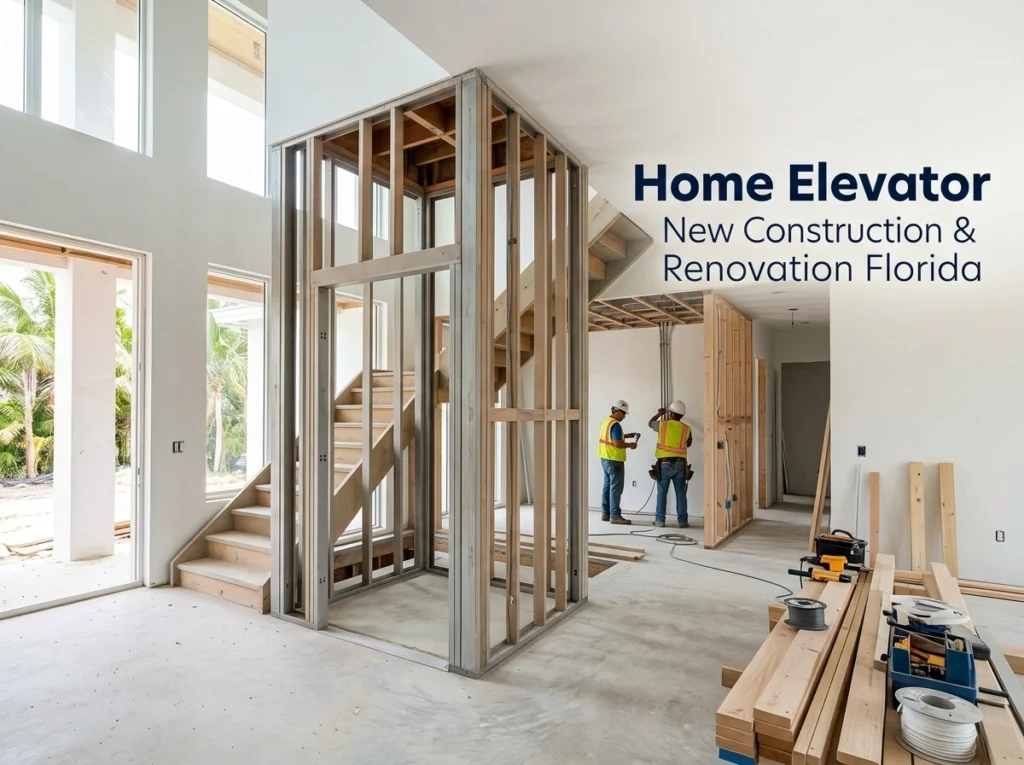
When an elevator is part of the original build, the shaft or hoistway is framed during rough construction alongside walls, floors, and mechanical systems. There is no finished drywall to remove, no flooring to protect, and no load-bearing elements to work around. The structural team is already on site. The framing crew can build the elevator shaft in hours rather than days. Electrical rough-in for the elevator circuit happens at the same time as all other rough electrical work. These efficiencies compound quickly.
By contrast, a post-construction retrofit requires contractors to open walls, cut through finished floors, and reroute existing framing members or utilities. Each of those steps adds labor, materials, and time. Finishing work to restore the home after installation adds another cost layer. On average, retrofitting a traditional shaft-based elevator into an existing Florida home adds $5,000 to $15,000 in structural and finishing costs beyond the elevator itself.
The construction savings from new-build installation are not limited to labor. Design flexibility also expands. During the blueprint phase, architects can position the elevator in the optimal structural location, size the shaft precisely to the selected elevator model, and integrate the machine room or electrical requirements without compromising living space. A builder who plans around the elevator from day one delivers a cleaner, tighter result than one who has to adapt a finished structure.
One client building a three-story luxury home near Panama City Beach initially set aside $40,000 for a post-construction elevator addition. After reviewing the project with Coastline Lift during the design phase, the team coordinated directly with the builder to include the elevator shaft in the original framing plan. The final installed cost came in well below the original estimate, and the shaft was sized precisely for the Savaria VueLift panoramic model selected for the home.
What Are the Real Costs of Installing a Home Elevator in a New Florida Home vs. a Renovation?
Residential elevator installation cost in 2025 and 2026 varies based on elevator type, number of floors, shaft design, and local permit requirements. For Florida coastal homes, there are additional considerations tied to wind-load compliance and salt air durability.
Here is a realistic breakdown:
New construction elevator installation (2-story home):
- Basic pneumatic vacuum elevator (PVE 30 or PVE 37): $25,000 to $38,000 all-in, including permits and installation
- Mid-range panoramic glass or acrylic elevator (Savaria VueLift series): $38,000 to $55,000
- Premium custom residential elevator (Level Up Whisper or Luma Lift, custom cab finishes): $55,000 to $75,000+
3-story residential elevator cost adds roughly $5,000 to $10,000 to each range above, depending on the elevator type and the additional structural and electrical requirements for the extra floor.
Home elevator renovation or retrofit cost:
Add $5,000 to $15,000 to the new construction ranges above to account for structural modification, finish work, and the additional labor involved in working within a completed home. Shaftless elevators like the PVE series reduce that premium significantly because they do not require a traditional hoistway.
Permits and labor are included in most full-service installation packages. In Florida, residential elevator permits are typically $500 to $1,500 depending on the county, with inspections required at multiple stages of installation.
It is worth noting that the home elevator 2 story cost and the home elevator installation cost 2026 numbers above reflect installed prices through a full-service provider. Equipment-only purchases through online resellers will carry separate installation and permitting costs that often exceed the savings.
How Do You Plan for a Home Elevator at the Blueprint Stage?
Planning a residential elevator new construction installation during the architectural phase is the single most effective way to control cost, protect design integrity, and ensure code compliance from day one.
Shaft and Hoistway Dimensions
The first step is confirming the elevator shaft dimensions required by the selected elevator model. Different models have different footprint requirements. The PVE 37, for example, requires a circular opening of approximately 37 inches in diameter with no traditional shaft walls needed, since it is self-supporting. The Savaria VueLift Round requires a minimum shaft opening of 48 inches by 48 inches. The Level Up Whisper requires a dedicated hoistway that varies based on the cab configuration.
Architects should receive the exact shaft specification sheet from the elevator supplier before finalizing structural drawings. A shaft built even two inches too small creates significant rework cost later.
Stacked Closets and Elevator-Ready Homes
One of the most practical new construction planning strategies is the stacked closets approach. Two or more closets placed directly above each other on consecutive floors create a natural shaft space that can be converted into an elevator hoistway at any point. This technique is standard practice among Florida luxury builders who want to offer buyers an elevator-ready home without committing to the full installation cost at the time of sale.
A home marketed as elevator ready in Florida commands a measurable resale premium. Buyers looking at multi-story coastal properties, particularly in the 55-plus demographic, frequently prioritize elevator-ready or elevator-installed homes over those without the infrastructure.
Electrical Requirements
Residential elevators require a dedicated electrical circuit. Pneumatic vacuum elevators typically operate on 220V/15A or 220V/30A. Hydraulic and traction models vary. The electrical rough-in must be coordinated with the elevator supplier before the electrician completes their rough-in work. Running this circuit as part of the original electrical package costs a fraction of what it costs to add it later.
Machine Room and Pit Requirements
Traditional traction and hydraulic elevators require either a machine room at the top or bottom of the shaft, a pit below the first floor, or both. Pneumatic vacuum elevators eliminate both requirements entirely. The PVE series is self-supporting, requires no pit, no machine room, and minimal structural modification. This makes PVE models an excellent choice for both new construction and retrofit applications, particularly in Florida beach homes where pier-and-beam foundations or crawl space depth can make pit construction expensive or impractical.
Can a Home Elevator Be Added to an Existing Florida Home?
Retrofitting a home elevator for an existing home in Florida is entirely practical, and the right elevator model makes the difference between a two-day installation and a three-week renovation project.
The most important variable in a retrofit is the structural path through the home. An elevator must travel through one or more floor/ceiling assemblies. In a standard wood-frame construction home, this typically means cutting through the subfloor and ceiling framing. In a concrete home, which is more common in Florida coastal construction, the work is more involved and requires core drilling or careful structural coordination.
Shaftless elevators, particularly the pneumatic vacuum models, are designed specifically for retrofit applications. Because the PVE cylinder is self-supporting, it does not require a traditional shaft built into the wall framing. It can be placed in a corner, in a living space, or in an existing closet opening. Installation typically takes two to three days, with minimal disruption to the home.
Common Installation Challenges for Home Elevators in Existing Homes
The most common challenges in retrofit installations involve three areas:
Floor structure access: Identifying and working around load-bearing elements at the cut-through point requires careful pre-installation assessment. Coastline Lift conducts a thorough site evaluation before every retrofit project to map the structural elements and identify the safest, most efficient installation path.
Electrical access: Running a new dedicated circuit from the main panel to the elevator location can require running conduit through finished walls. In some homes, the panel itself needs to be evaluated for available capacity.
Ceiling height variation: Many Florida beach homes have vaulted or coffered ceilings that affect the elevator’s travel height calculations. Accurate floor-to-floor measurements are collected during the site visit to confirm model compatibility before any work begins.
Beach house elevator installation in Florida also presents a durability consideration. Salt air accelerates corrosion on metal components. Every elevator that Coastline Lift installs in the Florida Panhandle is selected and specified with salt air resistance in mind. The PVE series uses aluminum and polycarbonate construction that does not corrode. Savaria VueLift models are finished with powder-coated or anodized components. All hardware selections are reviewed against the coastal environment before installation.
What Permits and Building Codes Apply to Home Elevator Installation in Florida?
Florida has one of the most clearly defined regulatory frameworks for residential elevator installation in the United States. Understanding this framework before the project begins prevents delays and ensures a smooth inspection process.
The Florida Building Code requires that all residential elevators comply with ASME A17.1-2019 (Safety Code for Elevators and Escalators) or ASME A18.1-2020 (Safety Code for Platform Lifts), depending on the elevator type. Platform lifts and vertical platform lifts fall under A18.1. Full passenger elevators fall under A17.1.
The Florida Bureau of Elevator Safety within the Department of Business and Professional Regulation (DBPR) oversees elevator permitting and inspection statewide. A permit must be obtained before installation begins. The permit application includes the elevator specifications, structural drawings, and the contractor’s elevator license.
Homeowners frequently ask: do I need a permit for home elevator installation in Florida? The answer is yes, without exception. Any residential elevator installed in Florida requires a permit, a licensed elevator contractor, and a final inspection by a state-certified elevator inspector before the elevator can be used.
Permits required for home elevator installation in Florida typically include:
- A mechanical permit for the elevator equipment itself, issued through the state DBPR
- A building permit for any structural work (shaft construction, floor penetrations, framing modifications), issued through the local county building department
- An electrical permit for the dedicated circuit installation, issued through the local county building department
In Florida’s coastal counties, including Bay County (Panama City Beach), Walton County (30A, Santa Rosa Beach), and Okaloosa County (Destin), local building departments may have additional requirements tied to flood zone construction, wind-load ratings, and foundation type. Projects in flood zones must comply with Florida’s 50% Rule, which restricts the extent of improvements to homes in certain FEMA flood classifications.
Coastline Lift manages the full permit sequence on every installation. The team is fully licensed under Florida’s elevator contractor requirements (License CRC#1333752) and coordinates directly with the county building department and state DBPR to pull all required permits and schedule all required inspections.
How Long Does It Take to Install a Home Elevator in an Existing Home?
The installation timeline for a home elevator in an existing home depends heavily on the elevator type selected.
Pneumatic Vacuum Elevators (PVE series):
Two to three days from start to finish. The self-supporting cylinder is delivered as pre-assembled sections, set in place, and connected to the electrical supply. No shaft construction, no pit excavation, no machine room. This is the fastest residential elevator installation method available.
Savaria VueLift panoramic elevators:
Three to five days, depending on cab configuration and the extent of shaft or opening preparation required. The panoramic glass or acrylic cab is assembled on site from modular components.
Level Up Whisper or Luma Lift:
Four to seven days, including hoistway preparation if required. These models are designed for clean architectural integration and may involve more precise alignment and finish work.
Should You Install an Elevator in a Luxury Custom Home Build in Panama City Beach or Destin?
A custom home elevator Florida installation is one of the highest-return investments a luxury builder or homeowner can make in a coastal Florida property, for reasons that go beyond convenience.
Property Value and Resale Impact
Residential elevators increase the buyer pool for a multi-story home. A two or three-story property with an installed elevator appeals to buyers of all ages, including those with current or anticipated mobility considerations, buyers seeking multi-generational living arrangements, and buyers who simply value the premium feel that an elevator brings to a luxury home.
The home elevator property value increase is difficult to assign a single number because it varies by market and property type. In Florida’s luxury home elevators Florida coastal markets, including 30A, Destin, and Panama City Beach, a high-quality residential elevator contributes meaningfully to perceived value and buyer interest. Builders who offer elevator-ready or elevator-installed homes in these markets report faster sales and stronger offers.
Aging in Place and Future-Proofing
Florida’s 50-and-older buyer demographic is one of the most active in the state. For this group, a home elevator is not an amenity. It is a planning decision. A home that includes an elevator at the time of construction is fully accessible from day one and remains accessible for the lifetime of the home.
A Certified Aging-in-Place Specialist (CAPS) designation from the National Association of Home Builders reflects the planning discipline needed to design homes that serve residents across all stages of life. Elevators are a core component of that planning framework.
Smart Home and Design Integration
Modern residential elevators are designed to complement the architectural language of luxury coastal homes. The Savaria VueLift series features 360-degree panoramic glass or acrylic cabins with custom interior finishes, LED lighting, and wood or metal cab trim options. The Level Up Whisper operates at near-silent levels with a Variable Frequency Drive motor and clean design lines suited to open-plan interiors. These are not utility products. They are design elements that elevate the visual and functional quality of the home.
Why Coastline Lift Is the Right Partner for Your Florida Elevator Project
Coastline Lift LLC is a locally owned and operated residential elevator specialist based in Panama City Beach, Florida, serving luxury homeowners, builders, and architects across the Emerald Coast. With over 200 successful installations, 10 or more years of Florida Panhandle installation experience, and a 5.0-star service rating, the company brings a level of local expertise that national providers cannot replicate.
Coastal Engineering Knowledge: Every elevator Coastline Lift installs is selected and specified with Florida’s coastal environment in mind. Wind-load compliance, salt air durability, and waterfront structural considerations are built into every product recommendation before the proposal is written.
No Subcontractors: The same certified team handles every step of the project, from the initial site consultation through the final state inspection. No rotating crews, no hand-offs, no communication gaps between phases.
Authorized Premium Brand Dealer: Coastline Lift is an authorized dealer for Pneumatic Vacuum Elevators (PVE), Savaria, and Level Up, three of the most respected elevator manufacturers in North America. Every product is USA or Canadian-made and carries full manufacturer warranty support.
Complete Permit and Code Management: From permit application to state inspection scheduling, Coastline Lift handles the full regulatory process. Homeowners and builders do not need to navigate the Florida Bureau of Elevator Safety or county building departments on their own.
Transparent Pricing and Free In-Home Consultation: Every project starts with a no-obligation site visit. The team evaluates the home’s structure, floor-to-floor height, electrical capacity, and preferred elevator location before providing a detailed written quote. There are no surprise charges after the project begins.
If you are working with a builder on a new construction project and want to coordinate elevator planning at the blueprint stage, contact Coastline Lift early. Connecting with the installation team before structural drawings are finalized takes less than an hour and can save thousands of dollars in rework.
Frequently Asked Questions About Home Elevator Installation in Florida
Is it cheaper to install a home elevator during new construction or as a renovation retrofit in Florida?
New construction installation is consistently less expensive because it avoids the structural modification, finish repair, and additional labor required in a retrofit. The savings typically range from $5,000 to $15,000 depending on elevator type and the complexity of the existing home’s structure. For shaftless pneumatic elevator models, the cost difference is smaller because minimal structural work is required in either scenario.
What is the best home elevator for a new Florida coastal or beach house?
The answer depends on the home’s design language and the homeowner’s priorities. For maximum design impact and panoramic views, the Savaria VueLift series offers 360-degree glass or acrylic cabins with custom finishes. For fast installation with minimal structural requirements, the PVE series is the most practical and cost-effective option. For near-silent operation with a clean architectural profile, the Level Up Whisper is the preferred choice among luxury custom builders.
What space requirements are needed for a home elevator in new construction?
Space requirements vary by model. The PVE 30 requires a 30-inch diameter opening with no traditional shaft needed. The PVE 52 requires a 52-inch diameter opening. Traditional traction or hydraulic models require a hoistway with minimum dimensions that vary by manufacturer, typically 48 inches by 48 inches or larger. Confirming exact requirements with the elevator supplier before the architectural drawings are finalized prevents costly revisions.
Do I need a permit to install a home elevator in Florida?
Yes. All residential elevator installations in Florida require a permit from the Florida Bureau of Elevator Safety, along with local building and electrical permits for any structural and electrical work. A licensed elevator contractor must pull the permits and be present for all required inspections. Operating a residential elevator without a permit and final inspection is a code violation.
How long does an installed residential elevator last, and what maintenance is required?
A properly maintained residential elevator has a service life of 20 to 25 years. Annual inspections are recommended and required under Florida building code. Routine maintenance includes lubrication of mechanical components, inspection of safety systems including emergency lowering and obstruction sensors, and testing of the battery backup system. Coastline Lift offers flexible maintenance plans for every elevator it installs, with scheduled inspections, part replacement, and 24/7 emergency support.
Conclusion
A residential elevator is one of the few home investments that improves daily function, increases resale value, and supports long-term accessibility all at once. For Florida coastal homeowners, the decision is not whether an elevator makes sense. It is when and how to plan the installation to get the best result.
New construction projects benefit from lower costs, greater design flexibility, and a cleaner structural outcome when the elevator is planned at the blueprint stage. Existing homes can be retrofitted efficiently with the right elevator model, particularly shaftless pneumatic systems that require no pit, no machine room, and minimal disruption to the finished interior.
Florida’s permitting requirements, coastal building codes, and wind-load standards add a layer of complexity that calls for a local specialist who knows the regulatory environment and the unique demands of Emerald Coast construction.Coastline Lift LLC in Panama City Beach, Florida, is the region’s most trusted residential elevator specialist, with over 200 successful installations across Panama City Beach, Destin, 30A, Santa Rosa Beach, and beyond. Call (850) 558-5331 or email sales@coastlinelift.com to schedule your free in-home consultation. The team is available Monday through Friday, 8 AM to 5 PM, and Saturday, 9 AM to noon.